
Stress and Pain: Examining Stress Levels
If you feel stress in your life, you are not alone. According to the American Psychological Association, although stress levels as a whole have been decreasing since 2007, only a small percentage of people polled report a decrease. They report that many of those feeling stress tend to lose sleep, lose interest or motivation, feel tired, are nervous and anxious, and are depressed. Also, many Americans report that the stress takes a big toll on their physical and mental health.
The NIH reports that the idea of our brain playing a role in pain perception began with the early Greeks and Romans. Since that time, a lot of information from scientific studies around the world has come to support the fact that our mental health, and particularly the amount of stress in one’s life, has a major impact when it comes to suffering from chronic pain.
Many people become stressed as they have difficulty coping with the day-to-day demands of their life. Others become stressed when they experience things such as death of a family member or friend, divorce, a job loss, pregnancy, financial problems, work problems, sudden negative changes, accidents or disasters, war, and natural disasters. The causal connection between stress and pain has been demonstrated in numerous studies regarding various types of pain and debilitating conditions.
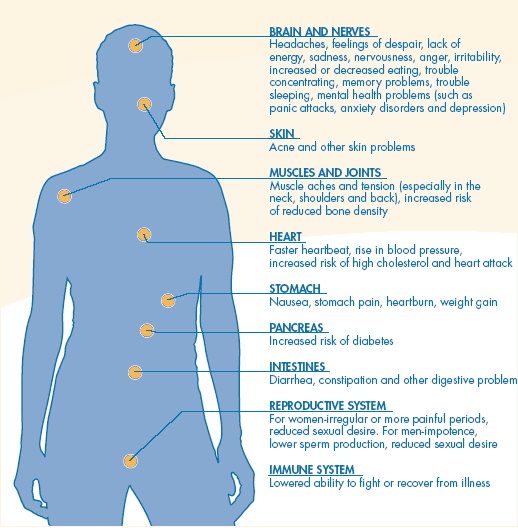
Research has been done in many areas, looking at the impact that stress has on pain and in people’s lives. Whether someone is suffering from chronic pain in their back, head, or other areas, there is a good chance that it has been brought on by the stress in their life, or is at least being exacerbated by the amount of stress they are experiencing.
According to the U.S. Department of Health and Human Services, some of the common signs of stress include headaches, upset stomach, back pain, and general aches and pains. Some of the various scientific research studies that have been done that show the causal connection between stress and pain include, but are not limited to:
- Headache: A study issued by the journal Headache in March 2013 reported that nearly 17 percent of adults have reported having one or more migraine or severe headaches within the prior three months. They also report that headaches are a common and major public health problem. In a December 2012 issue of the journal Pain, researchers found that headache activity was highest when there was high stress and low sleep occurrence.
- Back pain: The NIH reports that back pain is one of the most common medical problems, with nearly 80 percent of the adult population experiencing it at some point. Chronic back pain is estimated to impact around 31 million people in the country, according to the American Chiropractic Association. In a 2008 issue of Pain, doctors reported their research findings, stating that life events and the emotional distress factor play an important role in the development of disability.
- Abdominal pain: In the 2008 issue of the journal Pain, researchers reported that exposure to stress exaggerated abdominal pain experiences in children in both human and animal subjects that were studied. Those who underwent a stress test prior to the pain task tended to have lower levels of pain tolerances than those who did not first experience the stress test.
- Cardiovascular issues: Millions of people suffer from a variety of cardiovascular issues in the country. A 2009 report out of the University of Gothenburg in Sweden, reported that unexplained chest pain can be due to stress. They found that those suffering from the pain had a higher rate of depression, anxiety, and work-related stress.
- Post-Traumatic Stress Disorder: It is estimated that around 7.7 million Americans suffer from Post-Traumatic Stress Disorder (PTSD), according to the Anxiety and Depression Association of America. The incidence rate is especially high among combat veterans. PTSD is a psychological condition that someone experiences following a traumatic experience. Research reported in the October 2012 issue of Techniques in Regional Anesthesia and Pain Management finds that the rates of chronic pain among those diagnosed with PTSD is unexpectedly high. Further, they report that psychological and neurobiological factors are interacting together with PTSD.
- Depression: It was reported in the June 2014 issue of European Neuropsychopharmacology, that depression can influence pain, and vice versa. Aches and pains in the body are one of the common symptoms of depression. The NIH reports that those who are depressed have higher levels of the cytokine proteins that can impair the immune system and promote inflammation in the body, which leads to pain.
Chronic pain is something that plagues millions in the world, but not everyone experiences the effects of it in the same way. While some people may experience chest pains due to the stress they are feeling, others may find they have chronic headache pain, while still others have ongoing abdominal pain and discomfort. Many of the people who suffer from these conditions seek medical treatment, often in the form of looking for a cure or medication they can take to keep those symptoms at bay. What they too often overlook is the important role stress plays in all of this.
Reducing chronic pain and managing it is within reach for millions of the people who suffer from it. Taking on stress and winning is a great way to go about no longer being a victim to it. When you tackle the stress, you will be tackling the pain.
Stress and chronic pain go hand in hand, but the good news is that it’s in your hands, and you can make a difference when you understand the connection and take action against stress.
The bottom line is that when people are ready to confront chronic pain, there are answers. Understanding chronic pain and the factors that cause it is just part of the overall picture. But when you understand the causal connection between the stress in your life and the chronic pain you are feeling, then you are ready to confront it. Only when you truly confront it will you see a reduction in the chronic pain. It is within reach, the first step is choosing to confront your chronic pain!
Are you ready to look at stress and pain form a different perspective? Ready to rewire your beliefs? I use a technique called PSYCH-K ® to do so. Interested?
To book a session email: info@lucianapierangeli.com
Look after yourself.
Article Source:
EzineArticles.com/9200741
By Steven Richeimer